
It was a simple sign that planted the seed, creating a frisson of curiosity:
“Beware! Crocodiles inhabit these waters”.
That’s all it takes for our conversation to turn naturally, to what we think we know (and how we feel) about these ancient, feared creatures. We go back and forth, trading theories together with the occasional wondering. Of course, our antennae are up as we walk, scouring the distant riverbanks with nervous anticipation. It doesn’t take long for Steve to notice one languishing at water’s edge, basking in the early morning sun. We are (thankfully) high above it but have the perfect view. Keeping a very safe distance, we watch. In awe.
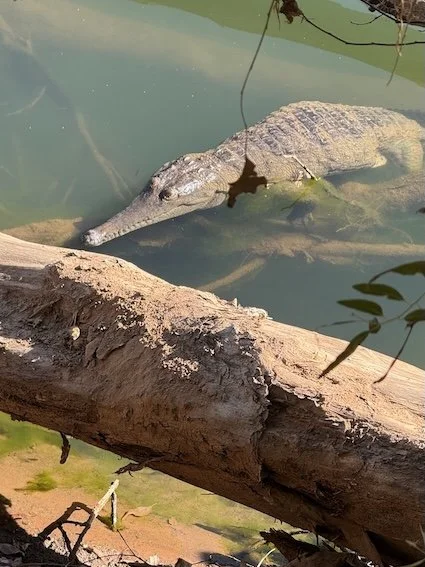
This is our encounter. It is as direct and authentic as it gets. At first, Steve and I whisper over each other in excitement but soon we fade to quiet. This moment requires reverence, listening and observing. The longer we observe, of course, the more we learn. Some of the theories shared as we set out on our walk are now being revised, affirmed or discarded. We are uncovering new information, slowly exchanging what we notice with each other and, of course, it is now that questions naturally start to emerge. Our questions are often accompanied by theories or tentative ‘answers’ … “How come …” followed by “maybe it’s because…”. “Yes but it could also be that …”. In the space and time this moment has allowed us, we are co-constructing. Together, we are weaving our prior knowledge with new information, building and dismantling theories and gradually refining the things we are particularly curious about. Like one side of ‘velcro’ , we are ensuring that any information we gather later is more likely to ‘stick’.
We were curious as we began this walk but this amazing, direct encounter has amplified our curiosity significantly. We are so ready to find out more! When we get back to camp, I am eager to learn. I want to find out– I am ready to receive information. I now have, what Susan Engel describes a “hungry mind.” It is at this point that information shared with me directly would have maximum impact.
Time spent in the natural environment has, yet again, help me think with greater clarity about the true nature of the pedagogy of inquiry and the conditions that help it flourish with authenticity and depth. ‘Sham inquiry’ is in abundance in classrooms and especially on social media- thank goodness that mother nature routinely re-connects me to the essence of this work! So, here are a few lessons from a crocodile about which I have been reminded:
Inquiry doesn’t have to begin with a question – in fact, it often doesn’t.
And questions merely for the sake of questions have limited value. Obviously, generating questions can help us learn about how questions work, but unless learners also experience the power of following the path questions those questions can take them and unless they are born of genuine curiosity, inquiry risks losing integrity. Questions emerge as we inquire – it is cyclical
Keep it real. All it took was a simple sign – a small seed was planted to trigger our interest. Not a grand or forced activity to hook us in (and I’ve designed plenty of those in my time!). The sign was authentic, contextual and relevant to where we were and what we were doing. If it feels like an effort to activate an inquiry with children, it may well be because the relevance and authenticity are missing. Considering the ways in which a journey of inquiry holds conceptual, cultural and contextual relevance to the lives of our children is an important part of planning conversations. And, by the way, another reason why generic, commercial programs can be so problematic.
Unearthing and sharing prior knowledge and theories prepares the mind for growth and understansing. We needed time to ponder possibilities, to anticipate and to learn from each other’s perspectives. Each of us had our own prior knowledge and theories - sharing those with each other helped ready our minds for the encounter to follow. In the same way, a journey of inquiry with children is made richer by opportunities to exchange theories, to share ‘first thinking’ with each other and to start to notice where genuine curiosity lies.
Direct, shared experiences are powerful opportunities for ‘finding out’ What better way to learn than through a direct encounter! This one involved (almost) all our senses (definitely not touch or taste!) and the sheer, visceral thrill of seeing this magnificent creature in the wild and up close. I maintain that direct, shared experiences are the bedrock of inquiry journeys and getting kids OUT into the environment (whether that be built or natural ) is key. It does not need to be exotic. I have watched master inquiry teachers make observations of pigeons in the playground as fascinating as our encounter with a crocodile.
Slow down and be quiet. Maybe that’s a sign I need to make and carry around with me when I am teaching. Our discoveries were SO dependent on us having slowed down long enough to notice detail. The more we noticed, the more we noticed. I was grateful NOT to have someone providing me with a running commentary. I was grateful that it was the crocodile teaching me at this point – not a tour guide. Expecting children to engage with information before they are ‘hungry’ to hear/read it seems so counterproductive. Genuine curiosity opens to the door to effective information gathering.
Questions may take their time to arrive. As already said, in our enthusiasm to teach children about questions, we run the risk of generating them for their own sake rather than in the service of actual inquiry. Too often, the absence of questions being asked is nothing to do with inability to formulate a question but everything to do with a lack of investment in and curiosity about the content. It can also be about timing. I had MANY more questions about crocodiles after having encountered one. I was invested - and given we were camping in the area, the information mattered to me!
Knowledge is cultural and each of us interprets and understands it through a personal lens. In my desire to learn more, I want to connect with ‘experts’ … but here in the far NW of Australia, the answers to my questions will depend on the cultural lens through which the knowledge provider views this animal. One lens might be traditional, indigenous knowledge, another through a western, scientific lens, another through a moral or ethical lens, and so on. The knowledge becomes richer and richer as I draw on multiple perspectives – listening directly to locals who live in close proximity as well as reading history and science. When we invite children to gather more information or seek answers to their questions and when we curate the resources we bring to the classroom, how deliberate are we about the perspectives being offered?
Inquiry is, ultimately, a way of being that is more than a collection of strategies and procedures. Over the years, I have included an abundance of strategies and processes in my books and use plenty in my workshops, but I recognise the inherent danger in doing so. It is all too easy to think we are ‘doing’ inquiry when we involve children in thinking routines, question generation, self-assessments, etc. But nifty routines and strategies alone do not inquiry make. Ultimately, learning through inquiry is what happens when we slow down enough to be open to complexity and uncertainty. Inquiry is about trusting that curiosity – a disposition we are all born with, will take root in our authentic encounters with the world. It is nurtured through practice , through both silence and dialogue and the gradual cultivation of dispositions such as curiosity, persistence, flexibility, courage and a willingness to sit in the uncomfortable place of not knowing. Inquiry is, of course, a stance. It is a way of seeing and being in the world and in the classroom. Unlike the frantic and inauthentic pace of many classrooms, inquiry happens best, as Margaret Wheatley famously argued, at ‘the speed of life’ .
As many of you begin a term or summer break, I encourage you to take a leaf out of Wheatley’s book. Slow down and experience the speed of life – you never know what magnificent encounter might be waiting for you and what it will teach you.